
 Global
Environmental Goals
In the international community, the movement towards achieving a sustainable society is accelerating. For example, Sustainable Development Goals (SDGs*1) have been agreed upon in 2015, and the Paris Agreement,*2 an initiative aiming at the realization of a zero-carbon society, has come into force. In response, the Ricoh Group conducts its environmental management by setting environmental goal of achieving a “zero-carbon society” and “circular economy.”

- *1Sustainable Development Goals (SDGs): These are shared global goals that were agreed at the United Nations, which stipulated global priorities and the ideal targets to be reached by 2030. The SDGs comprise 17 goals and 169 targets.
- *2 The Paris Agreement: This international agreement was adopted at COP21 and specifically addresses the issue of global warming. It was agreed that it is essential to hold the increase in global average temperature to well below 2°C above pre-industrial levels, achieving a balance between GHG emissions and absorptions by the end of this century.
Setting goals using the back-casting method, aiming to improve the Earth’s self-recovery capabilities
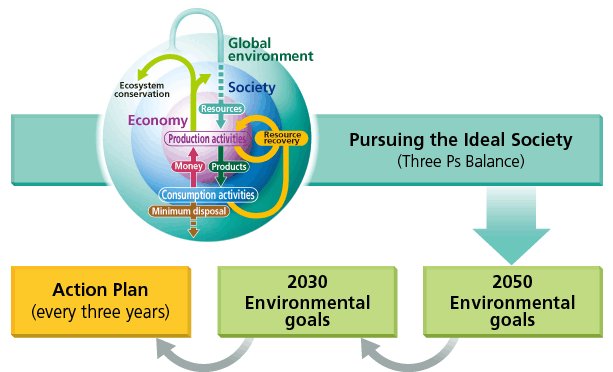
The Ricoh Group uses the back-casting method to set goals. In this approach, we first set final goals and then determine target values as milestones on the journey to these goals. As the milestones toward the final goal of the Three Ps Balance, we have set environmental goals for 2030,2040 and 2050 in the area of zero-carbon and for 2030 and 2050 in the area of resource conservation.
We use these goals in the Action Plan, which we issue every three years based on our mid-term management strategies in order to develop highly effective actions to achieve our environmental goals for 2030.
We recognize that it is important to maintain and restore the Earth’s self-recovery capabilities while reducing the damage to the environment. We conduct forest ecology conservation activities around the world for this purpose, and we are encouraging our customers and local communities to join the activities.
Setting environmental Goals
‹Ricoh Group Environmental Declaration›
We proactively reduce environmental impact and strive to improve the Earth’s self-recovery capabilities to achieve
a zero-carbon society and a circular economy through business.
Outline of Environmental goals
| Environmental goals |
All GHG emissions reduction rates are compared to 2015 level.
|
||||||||||||||||||||||||||||||||||||||||||||||
|---|---|---|---|---|---|---|---|---|---|---|---|---|---|---|---|---|---|---|---|---|---|---|---|---|---|---|---|---|---|---|---|---|---|---|---|---|---|---|---|---|---|---|---|---|---|---|---|
| Concept |
|
||||||||||||||||||||||||||||||||||||||||||||||
| Major activities |
|
||||||||||||||||||||||||||||||||||||||||||||||
| Performance |
|
||||||||||||||||||||||||||||||||||||||||||||||
*Due to changes to the Ricoh Group's organizational structure and improved data accuracy, we revised the past data
*Figures in this table to be updated with FY2025 result
| Environmental goals |
‹Goals for 2030› ● Virgin material usage ratio*1: 60% or less ‹Goals for 2050› ● Virgin material usage ratio*1: 12% or less *2
|
|||||||||||||||
|---|---|---|---|---|---|---|---|---|---|---|---|---|---|---|---|---|
| Concept |
|
|||||||||||||||
| Major activities |
|
|||||||||||||||
| Performance |
|